
'We'll lose teachers': strike action begins as Fleetwood school ordered to become an academy by Catholic Church
The decision over whether to convert has been taken out of the school’s hands.
Plans to force a school in Fleetwood to become an academy could cost it up to five teachers, a union has claimed.
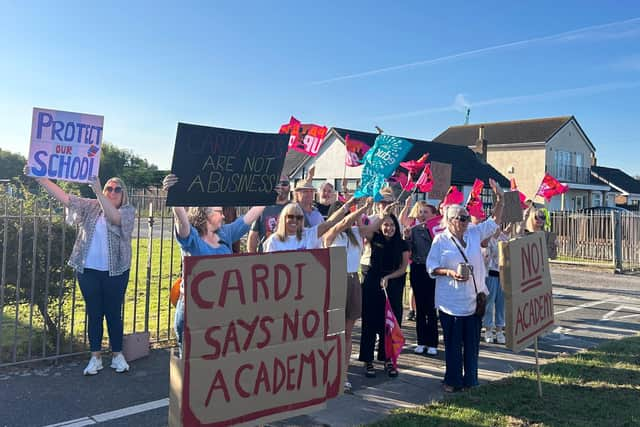
Members of the National Education Union (NEU) at Cardinal Allen Catholic High went on strike on Tuesday in response to a push by the Catholic Diocese of Lancaster to bring all of its schools under the umbrella of a multi-academy trust (MAT).
The Melbourne Avenue school was able to accommodate only year 7 pupils during the one-day walkout - and a 48-hour stoppage is now planned for 21st and 22nd September.
The NEU is calling on the Bishop of Lancaster, Paul Swarbrick, to ditch his policy of directing all diocesan schools to join one of the church’s three own MATs - a move that it says will drain vital funds away from the classroom.

Bishop Swarbrick set out his intention back in 2020 for all Catholic schools in the Lancaster Diocese – which covers the Fylde coast, Central and North Lancashire, and Cumbria – to convert to academies by the end of the current 2025/26 academic year. The vast majority of them have already made the switch.
When a school becomes an academy, it leaves the control of the local education authority for that area – Lancashire County Council in the case of Cardinal Allen – and joins a trust or sponsor.
All the latest news direct to your inbox
Academies have more flexibility than maintained schools – including an option to deviate from the national curriculum in some areas and to set their own admission arrangements and term times. Bishop Swarbrick has previously said he wants to use academy status “to protect, secure and develop the Church’s mission in education through greater collaboration and support between our school communities and parishes”.
However, the NEU says academies have to sacrifice some of the funding they previously received as maintained schools, because the not-for-profit MATs “top slice” academy budgets to fund the central services that would previously have been provided by the local authority. The union also claims that this cash is “used to maintain the high salaries of central executives who don’t teach”.
Nat Kerray – a curriculum leader and NEU rep at Cardinal Allen – told The Gazette that his school had previously explored becoming an academy, but concluded that it “just wasn’t in anyone’s interest in terms of the the money it would cost – [given] the teachers we’d have to lose and the impact it’d have on the classroom”.
He added: “Going from paying what we pay Lancashire County Council now to what we would pay the MAT, we’d have to lose possibly five teachers.”
Mr. Kerray said attempts to discuss the school’s concerns with the Diocese had been met with a “dismissive” response.
“They’re just saying, ‘This is happening and we’ll force it through if [we] need to,’” he said.
Lancashire NEU brach secretary Ian Watkinson appealed for Bishop Swarbrick to guarantee that no school will be forced to become an academy – and claimed that some of those that had done so willingly were already regretting their decision.
“There are plenty of headteachers that have converted [their schools] who are concerned, because the MATs don’t have the same capacity to provide the support that’s needed – and the level of top slice is impacting what they’re able to deliver.”
Responding to the issues raised by the NEU, a spokesperson for the Diocese of Lancaster said: “The National Education Union is opposed to the creation of academies in principle, whether forced or voluntary.
“The conversion of schools into academies is, however, both the policy of government and that of the Bishop of Lancaster.
“It is our conviction that academy trusts will guarantee high-quality Catholic education throughout the Diocese. The majority of our schools in this area have already joined their Trust family and are flourishing.
“We therefore regret that the decision has been taken to proceed with strike action.
Our sympathy lies with pupils who are losing a day of education and for parents who will be inconvenienced by this action.
“We sincerely hope that the NEU will reconsider their position.”
Andrew Cafferkey, headteacher of Cardinal Allen High School, said: “Parents and carers were informed in advance that members of the National Education Union were taking part in industrial action [on Tuesday].
“Our school opened to pupils in Year 7 only, but [was] open to all students [again on Wednesday].”
Twenty out of the 22 Lancaster Diocesan schools in Blackpool, Fylde and Wyre have so far joined the Blessed Edward Bamber Catholic MAT. Only Cardinal Allen and St Bede's Catholic High School in Lytham are yet to do so.
Ian Watkinson said it would be “understandable” if those Catholic schools across the Diocese that had not yet converted also considered taking industrial action if they, too, were alarmed at the prospect of being “forced down an academisation route that simply isn’t right for their setting”.
The Lancashire County Council area – which excludes Blackpool and Blackburn with Darwen – has seen a far slower academy conversion rate than the national average. As of January 2026, just 20 percent of schools in the County Hall patch are academies or free schools – 128 out of 618.
Across England, the proportion was 46 percent in January 2025, the latest date for which figures are available.
Academy history
When academies were first created in the early 2000s, they were seen by the then Labour government as a way of driving up standards in failing schools.
The coalition government opened up the programme to all schools a decade later and encouraged them to convert in high numbers.
Schools rated inadequate by Ofsted were later ordered that they had to join an academy trust on the basis that the support they would receive would help them to improve.
In its ‘Every Child Achieving and Thriving’ white paper, published earlier this year, the current government set an expectation that all state-funded schools will join or form a “school trust” in order to extend the number of multi-school groupings across the education system.
However, under that plan, local authorities would, for the first time, be allowed to establish their own trusts – potentially slowing the 15-year trend of councils having less involvement with schools.