
Unknown Lancashire soldier's grave is finally found in Belgium
A previously unknown grave of a Lancashire Fusilier has been discovered in Belgium, bringing closure to a century-old mystery.
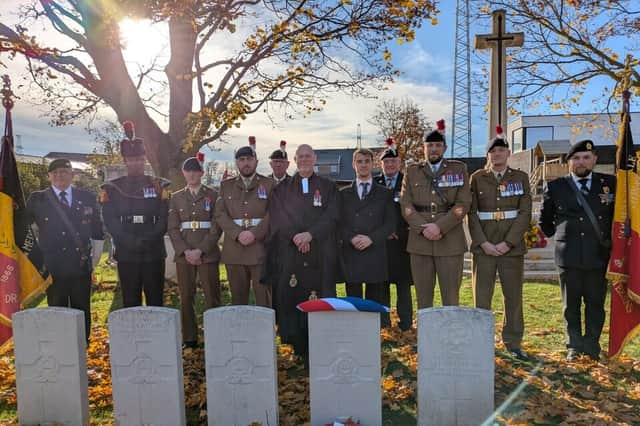
A rededication service took place yesterday for Private George Hall, who died just two weeks before the end of the First World War, and who had previously been known as an ‘unknown soldier’.
Services for two other soldiers who have also been identified - Lieutenant Norman Frederick Hunter and Serjeant George Goodson Moore DCM - were also held at CWGC Vichte Military Cemetery near Kortrijk.
The services were organised by the Ministry of Defence’s Joint Casualty and Compassionate Centre (JCCC), known as the ‘War Detectives’, and were conducted by the Rev David Jeal CF, Chaplain to The Royal Dragoon Guards and attended by serving soldiers of 1st Battalion The Royal Regiment of Fusiliers and 5th Battalion The Rifles.
Rosie Barron, JCCC Caseworker, said: “As the nation stops this week to remember service personnel who paid the ultimate sacrifice in war, this has been a poignant time to rededicate the graves of these three brave men. All died at different stages of a long war as the frontline ebbed and flowed through Flanders. All of these men left behind families who would have mourned their loss and who were left with unanswered questions as to their exact fate. It has been a privilege to have played a part in bringing these men’s stories to a conclusion.”
Rev David Jeal CF said: “In rededicating the graves of Lt Hunter, Sjt Moore and Pte Hall, we honour not only their service but their enduring place in our shared history. These soldiers’ courage and commitment reminds us of the cost of peace and the duty we all share to remember. It is a privilege to speak Their names once more, with gratitude and respect.”

Pte Hall, aged 31, was born in Stratford, Essex. He was initially posted to 1st Battalion The Lancashire Fusiliers and appears to have been sent to Gallipoli where the battalion was engaged until January 1916 before it was evacuated to Egypt. The battalion was transferred to the Western Front in March 1916 and heavily enaged in the Battle of the Somme that summer.
At some stage Pte Hall was transferred to 17th Battalion The Lancashire Fusiliers. By late October 1918 the static warfare which had kept British forces in Belgium around the Ypres Salient since 1914 was over and they were rapidly heading eastwards through Belgium towards the German border. On October 27, 1918, the battalion was in action around Avelgem, east of Kortrijk. Their positions were heavily shelled all day and Pte Hall was killed just 2 weeks before the cessation of hostilities.
All three men had previously been commemorated on either the Menin Gate or Tyne Cot Memorial to the missing. The CWGC has now replaced their headstones with named markers and will care for them in perpetuity.
Polly Brewster, Case Officer for the Commemorations team at the CWGC, said: “More than a century after their deaths, we are honoured to have played a part in identifying the resting places of these three men and installing headstones that now bear their names. George Hall, Norman Frederick Hunter and George Goodson Moore were husbands, brothers and sons. They came from different backgrounds and lived different lives, yet they were united by their common sacrifice. Today’s rededication services are a poignant reminder of the human cost of war and offer a moving moment of reflection during this national period of remembrance.”