
Quick-thinking Blackpool Zoo keepers save the life of adorable newborn porcupine named Dougie

Keepers at Blackpool Zoo have successfully hand-reared and rehabilitated a newborn North American tree porcupine that would not have survived without intervention.
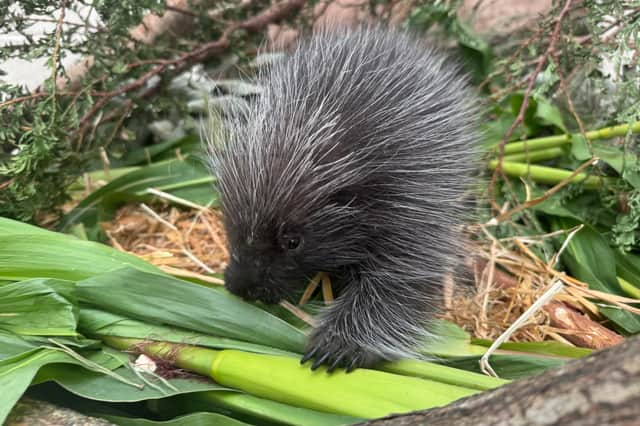
Affectionately named Dougie, short for Douglas after the Douglas Fir tree native to his species’ North American home, the adorable porcupette was born on Thursday, May 22, to mum Willow and dad Simon weighing just 468 grams and measured around 20cm.
Keepers quickly realised he was struggling to move properly. He was displaying limited use of his hind legs, which was possibly due to birth trauma, and was unable to feed naturally.


Despite allowing a critical 24-hour bonding window in the hope that Dougie would gain vital colostrum from his mother’s milk, the team had to make the decision to intervene to save him.
It is the first time the zoo has ever hand-reared this species and babies, or porcupettes, are born covered in quills, which makes physical care a real challenge.
He was moved to a temperature-controlled brooder and took very well to the bottle over the next few days, with keepers encouraging movement and stimulus in his back legs with a physio regime.
They used a published guide from America, where the species is regularly rehabilitated in the wild, as a basis for his recovery.
He was initially fed every two hours with a carefully formulated milk blend developed by the zoo’s vet nurse and he soon began to gain strength.
Ongoing physio and daily leg exercises helped him gradually regain full movement and his loud squeaks for breakfast became part of the team’s daily routine.
By two-and-a-half weeks old, Dougie was strong enough for brief visits with mum Willow, who responded calmly and positively. They were both moved into a specialist care area to allow keepers to keep a close eye on them.
Jason Keller, Senior Keeper at Blackpool Zoo, is delighted with his progress.
He said: “Dougie is now two months old, weighs around 2kg and is permanently living with his mum, which is fantastic!
“He’s exhibiting all the natural behaviours expected of his species including climbing, chewing browse and suckling.
“In addition, he has already achieved many milestones from taking his first steps to deciding which logs are his favourite to climb on and tasting solid foods such as root vegetables and tree bark.”
While the zoo has housed this species for more than 30 years they have never hand-reared them.
Keepers who live onsite were taking up the night shifts when he was feeding round the clock.
Jason added: “It isn’t easy to give daily physio therapy sessions to an animal that is so small and so spiky, but everyone was determined to give him the best possible chance.
“We only hand-rear in extreme circumstances and we knew Dougie would not have been able to feed from his mother due to his initial mobility issues.
“His survival marks an important milestone in Blackpool Zoo’s animal care history and is a testament to the skill and commitment of the team.”
What is a North American tree porcupine?
The North American tree porcupine is a large, slow-moving rodent native to the forests of Canada, the United States and parts of northern Mexico. They have a distinctive coat of sharp quills.
They are primarily nocturnal and spend much of their time resting in tree branches or sheltered dens.
They are not currently endangered but their populations are monitored in the wild due to habitat loss and road mortality.
In zoos, they play an important role in conservation education and help raise awareness about the diversity of rodent species in North America.