
The second part of the Big Interview with Tony Rodwell:Rodders was a late arrival to the professional game
In part two, Craig Salmon talks to former Blackpool winger Tony Rodwell
Tony Rodwell always wondered whether he was good enough to make it in the Football League.

In spite of starring regularly in the non-league game, no clubs higher up the football pyramid appeared willing to give him an opportunity.
His silky skills on the right wing for outfits such as his hometown club Southport, Buxton and Runcorn had made him a firm crowd pleaser. He appeared destined to be bracketed in that group of players who were too good for non-league defences, but deemed not good enough to trouble those in the professional game.
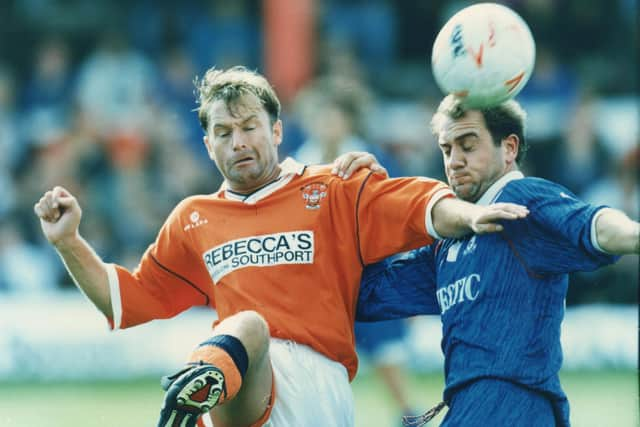
Being regarded as one of the finest players never to play in the Football League was a mantle Rodwell took great pride in.
There was always a burning desire within to prove himself in the full-time game – he just needed a club to believe in him.
Eventually, after a particularly outstanding season for Colne Dynamoes where he inspired the club to the Northern Premier League Premier Division title, Rodwell got the chance he had been waiting for.
After Dynamoes abruptly went out of business in the summer of 1990, Blackpool boss Graham Carr came calling for his services.
And so, just a few days’ shy of his 28th birthday, the wing wizard fulfilled his Football League dream when he made his full debut for the Tangerines, scoring in a 4-1 win against Wrexham at Bloomfield Road.
“I remember one of the directors at Blackpool rung me and asked if I wanted to go on trial,” Rodwell recalls. “There was me, Dave Lancaster and Simon Westwell from Dynamoes who went on trial.
“We played a pre-season game at Harrogate and I came on at half-time. I did alright and the manager wanted to see me after the game. I’ll never forget it because Graham Carr, he was wearing a vest – he didn’t look like a manager, he looked like a groundsman.
“He was a nice guy and he said to me, ‘We are thinking of signing you but we want you to play against Burnley at Turf Moor in a Lancashire Cup game.
“All three of us played but they ended up just signing myself and Dave Lancaster.
“I remember though, Cambridge United – who were managed by John Beck – came in for me.
“Gary Johnson who was John Beck’s assistant, rang my wife up at home while I was on trial at Blackpool.
“I think I had agreed to sign for Blackpool but they told my wife that they were going to offer me loads of money, but there were no mobile phones in those days so she couldn’t ring me up and I had already given my word to Blackpool.
“I couldn’t renege on it but I signed for Blackpool for less money than what Cambridge were offering and probably less money than what I was earning at Colne Dynamoes.”
After years of doubting whether he could make it at the higher level, Rodwell found the professional game very much to his liking.
In four years on the Fylde coast, he made an indelible mark on the Bloomfield Road faithful.
With the inspirational Billy Ayre replacing Carr as manager, Rodwell’s first two campaigns as a Seasider resulted in promotion campaigns and Wembley appearances.
The 1991 Fourth Division play-off final would end in tears as Pool were beaten via a penalty shootout, with Rodwell missing from the spot, by Torquay United.
Happily, a year later, Rodwell cried tears of joy as the Seasiders claimed promotion by beating Scunthorpe United, on penalties, at the home of football.
From playing Northern Premier League football just a couple of years earlier, Rodwell found himself playing in the third tier of English football.
Although the Seasiders would struggle over the next couple of years, narrowly avoiding relegation, Rodwell felt at home playing in the old Third Division – and even felt he would have been capable of playing higher.
“The standard was good in the Third Division,” said Rodwell. “There were some really good teams and we went to some really nice grounds.
“I didn’t feel out of place – in fact I felt like I could have played higher to be honest.
“I enjoyed it and generally thought I did well.
“The home games were good because we were strong at Bloomfield Road with our fans backing us but the away games were tough.
“We were coming up against players who had dropped down through the leagues and it was hard for us to compete at times.
“I just think we needed a few more signings, but we just didn’t have the money to get the players that we needed.
“We lost a few players too – David Eyres went, Paul Groves went – and we didn’t really replace them.
“We didn’t really push the boat out to stay in the league – we did stay in the league in the end – but it was a battle.”
On a couple of occasions, Rodwell got the opportunity to test himself against players operating at the highest level; including one of England greatest ever midfielders, Paul Gascoigne.
In the season following the 1990 World Cup in Italy, Blackpool were drawn at home to Tottenham Hotspur in the third round of the FA Cup.
As well as Gascoigne – who was at the peak of his powers as a player – Spurs also had legendary goalscorer Gary Lineker up front and other household names such as Gary Mabbutt and Vinny Samways in their line-up.
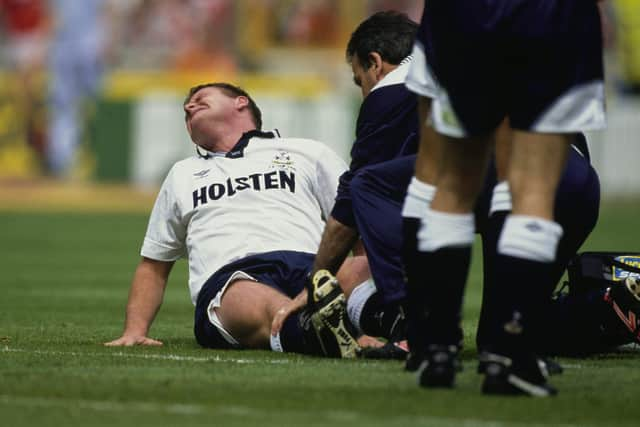
Spurs would go on to lift the cup that season, memorably beating London rivals Arsenal 3-1 in the semi-final before coming back to beat Nottingham Forest 2-1 in the final – the match which is synonymous with Gascoigne being stretchered off with a serious knee injury.
However, they were given a huge scare by the Seasiders with Rodwell seeing his goal chalked off for a dubious foul, before ex-Seasider Paul Stewart bagged the only goal of the game 22 minutes from time following Gascoigne’s free-kick.
“I remember when I was in non-league, the dream was to reach the first round proper of the FA Cup and draw a Football League team,” he added.
“I did that once for Runcorn, we got drawn against Wrexham. I’ll always remember that because they had a good team and we drew 2-2 at home and then beat them 3-2 at the Racecourse Ground in the replay.
“I think I set two up and then scored the winner in the last minute, but to play against Gazza was a dream come true.
“We gave them a good game and obviously they went on to win the cup that year.”
Next week: Read the third and final part of the Tony Rodwell story