
I'm a Lancashire mum who battled breast and cervical cancer, I am urging for a breakthrough

I’m a Lancashire mum who was told I had breast cancer when my youngest was just four months old, now I’m backing a Cancer Research UK campaign to help fund more big breakthroughs.
45-year-old Rebecca Oldham from Accrington had already lost her aunt Nicola to breast cancer aged 40 whilst her mum had also been successfully treated for the disease.
Due to her family history, Rebecca was offered genetic testing and was found to carry the faulty BRCA1 gene- which increases the risk of breast, ovarian, prostate and pancreatic cancer - back in 2015 when her first child Emily was aged eight months old.
As Rebecca and her partner Steven were both keen to have another child, they didn’t take the option of preventative surgery to remove Rebecca’s ovaries but then in 2017, came the hammer blow of Rebecca’s breast cancer diagnosis.
She had found a lump when breast feeding baby Jack and initially hoped it was a blocked milk duct, but when the lump didn’t go away, extensive tests revealed she had triple negative breast cancer.


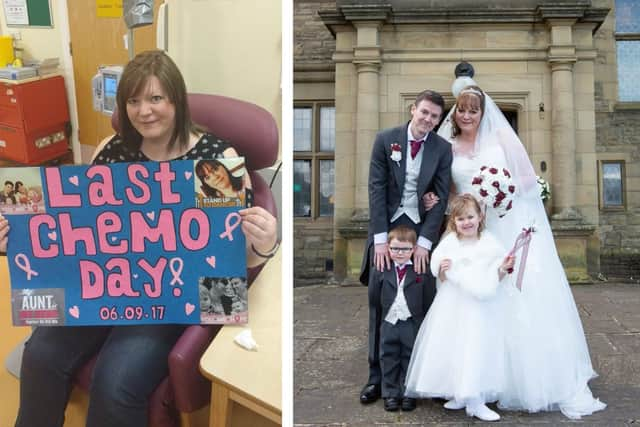
The mum of two, at this point aged 38, faced eight months of gruelling treatment, including having her right breast removed.
Then just months after she had recovered from the treatment and surgery, Rebecca was diagnosed with cervical cancer - a cancer type that is not related to BRCA faults.
She had to have chemotherapy, radiotherapy and brachytherapy (which involves giving radiotherapy to cancer from inside the body.)
Rebecca became very poorly during this time and ended up in hospital with sepsis but she made a good recovery meaning she was able to have her left breast removed as a preventative measure.
She also decided to have her ovaries and fallopian tubes removed last year but due to scar tissue caused by all her treatment, the surgery was unsuccessful. However, a consultant is attempting the surgery again on Oct 31.
Now, Rebeeca is studying a degree and training to be a counsellor, whilst she also married Steven just before lockdown, their children Emily and Jack now being nine and eight.
Why is Rebecca telling her story now?
Thirty years ago this month, Cancer Research UK scientists were at the forefront of the discovery of the BRCA genes – helping to unlock the knowledge that faults in these genes increase people’s risk of developing certain cancers.
As Rebecca knows all too well, around 70% of women with faulty BRCA1 or BRCA2 genes will develop breast cancer by the age of 80.
But the Lancashire mum feels, “forewarned is forearmed” and three decades later this breakthrough is saving the lives of people like her by revolutionising how these cancers are prevented, diagnosed and treated.
Rebecca credits research with her survival and that’s why she’s sharing her experience during Breast Cancer Awareness Month to shine a light on how people across Lancashire can help drive more discoveries by donating monthly to the charity.
She said: “As soon as I heard the words, ‘It’s cancer,’ I was convinced I wasn’t going to see my children grow up. Then I had to go through it all again just a few months later when I was re-diagnosed.
“It was devastating. But it’s something I’ve had to come to terms with, helped by knowing that – thanks to Cancer Research UK - so many preventative measures and targeted drugs are now available because of this landmark discovery.
“The size of the prize that has come from investing in BRCA research over the last 30 years is remarkable. And most important of all, it has given families like ours hope. Advances like this simply wouldn’t be possible without regular monthly donations from the public that keep the charity’s scientists researching month in, month out. This vital work needs our support to help create more ‘Eureka!’ moments.”
The charity has been responsible for a new family of drugs called PARP inhibitors. Often used to treat people with faulty BRCA-driven cancers, researchers are now exploring how they could be used to treat many more types of the disease.
Rebecca added: “Knowledge is power and now I feel the children and I can look forward to a better and brighter future. Cancer Research UK has helped to change the course of my family’s cancer story, so I’m determined to help raise vital awareness and funds.
“We have been very open with our children about my cancer treatment and we will discuss the inherited gene with them when they are older. I feel incredibly lucky to still be here as I didn’t think I would make it to Jack’s first birthday or see Emily join primary school. And now we are looking at secondary schools for Emily. All these amazing milestones.”
With around 44, 700 people diagnosed with cancer every year in the North West Rebecca’s message is clear – to save lives tomorrow, the charity needs people’s support today.
What has the charity said?
Cancer Research UK spokesperson for the North West, Jane Bullock, said: “Together, we are beating cancer. From understanding DNA repair and helping to discover the BRCA genes to developing treatments for faulty BRCA-driven cancers, we’re making huge leaps forward thanks to the generosity of our supporters. So, we’re grateful to Rebecca for helping to highlight the enormous difference a regular income makes to our work.
“It means we can plan ahead, committing to long-term research projects with huge potential to help save more lives. And because of monthly donations we can learn more, faster and accelerate progress.
“We hope people will consider giving regularly to the charity, if they can, because our work isn’t done yet. We want to bring about a world where everybody lives longer, better lives, free from the fear of cancer. No matter who they are or where they’re from.”
Donate monthly to Cancer Research UK at cruk.org/donate