
Blackpool Zoo expert's groundbreaking research shown on BBC show
How do sealions catch their prey in pitch darkness?
That’s the question Blackpool Zoo’s Alyx Milne answered on BBC One’s Ingenious Animals last night.
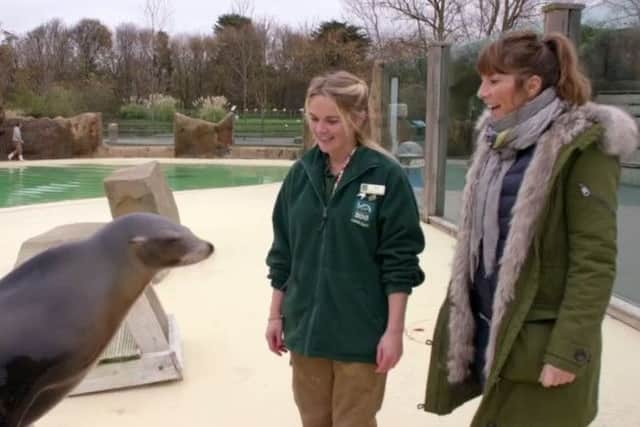

The 29-year-old, who is studying marine animals for her PhD while working full time at the zoo, has cracked the mystery after three years of research.
Viewers saw Alyx, who commutes to work from Liverpool every day, conduct an experiment in complete darkness with Californian sealion Anya and zoologist Lucy Cooke.
They watched as Anya caught and controlled a ball by using her whiskers instead of her eyes.
Lucy said: “That just proves it. I can’t see a thing, she can’t see a thing. She has to be doing that using just her whiskers.”
Alyx told The Gazette her colleagues at the zoo have been supportive of her while she conducts her ground-breaking research.
She said: “They know how much work I have been putting in, working full-time and doing a full-time PhD.
“They have been really supportive. With the backing of the uni [Manchester Metropolitan] and the zoo, when there’s a hole in education and science, if you have the knowledge, you can always find new things out.”
Last night’s episode of Ingenious Animals can be seen on iPlayer at: http://www.bbc.co.uk/iplayer/episode/b07wsnpq/ingenious-animals-4-bodies