
Blackpool MP Chris Webb: Blackpool has enormous pride and potential - it is not ground zero for social decay

A Blackpool MP has spoken out in Parliament defending his hometown after it was labelled ‘ground zero for social decay’ in a national newspaper.
Chris Webb, MP for Blackpool South, hit out at the Telegraph for reducing all the hard work going on to improve deprivation in the town ‘to another national headline’.
The Telegraph article said “Blackpool is a microcosm of all that’s wrong with Britain”.
The scathing attack on the town said it was ‘an epicentre of inactivity’ and demanded the government act to re-instill vocational pride in young people before it’s too late.
In October, the Ministry of Housing, Communities and Local Government updated the English Indices of Deprivation for the first time since 2019.
The Indices rank small areas in England according to deprivation across multiple domains – looking beyond income alone and taking account of housing, access to services, education, employment, health, crime and the living environment.
Blackpool obviously ranked highly. It is home to seven of the top 10 most deprived areas of the country.


But jumping to the defence of his hometown, Mr Webb said in Parliament: “Blackpool has enormous pride and potential.
“Despite the challenges captured in these statistics, people in our town won’t be defined by them.
“Our communities are strong, our young people are ambitious and our organisations drive change every day. This spirit of resilience and determination is the foundation on which renewal can be built.
“With the right support, investment and political will, that local energy can be harnessed to transform opportunity, improve lives and rewrite the story of our town.”
The Telegraph artcle written by Sherelle Jacobs said: “When I visited Blackpool, an epicentre of inactivity – where almost one in three are jobless – I glimpsed the pitfalls in Labour’s plan. Blackpool is where technocratic solutions come to die.

“A bid to reinvent it as Britain’s Las Vegas ended in two decades of urban blight. “Silicon Sands” – a project to build a data centre superpark powered by the town’s undersea internet cables – is lagging due to the local skills gap. From Kickstart to Restart to Build Up, the town is a graveyard for job schemes.
“The Department for Work and Pensions’s new £100m Art Deco glass edifice in Talbot Ward, where life expectancy is on par with Eritrea, symbolises Westminster’s failure.”
But the Telegraph article failed to mention the revoluntary work ongoing to build a £65m Multiversity in the centre of the town.
The Multiversity, which will be home to around 3,500 students and staff and be part of Blackpool and the Fylde College in association with Lancaster University, is due to open in September 2027.
Students will be offered a curriculum including computer and digital technology, leadership management and lifestyle, engineering and science, society health and childhood and construction.
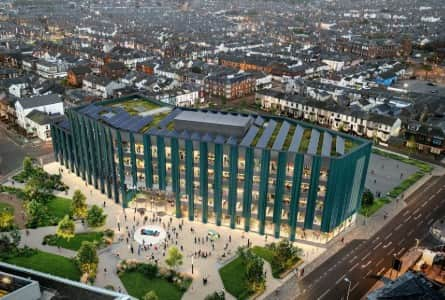
The Multiversity campus will be delivered through a partnership involving Blackpool Council and will be a unique proposition, providing a cutting-edge response to local, regional, and national priorities, designed to accommodate up to 3000 learners.
Key benefits of the multiversity include:
Improving skills and opportunities – The investment in a new, high-quality, purpose-built educational facility will provide an unrivalled learning environment, encouraging more learners to choose to continue with their education in Blackpool. A tailored curriculum, catering for needs of employers in order to fill skills gaps across the Fylde coast, means the Multiversity, by virtue of what is taught there, will link directly to employment opportunities
Supporting town centre regeneration – The development of the Multiversity adjacent to the town centre will complement other major developments, including the developments at Talbot Gateway, the extension to the Houndshill Shopping Centre and the new Winter Gardens Conference and Exhibition Centre, in providing year-round footfall into the town centre, reducing the impacts of seasonality
Built environment uplift – The Multiversity’s development will provide uplift to an area that has not previously benefitted from significant investment, improving the area significantly
Chris Webb said the updated English Indices of Deprivation should convince the government ‘that action must focus on Blackpool’.
He said: “My hometown of Blackpool is often talked about as a place in decline rather than a place of possibility.
“Just last week it was reduced to another national headline as the Telegraph called it ‘ground zero for social decay’.
“It’s seen as a symbol of what has gone wrong, rather than understood as a community living with the sharpest edge of national failure.
“In October, the Ministry of Housing, Communities and Local Government updated the English Indices of Deprivation for the first time since 2019, marking a rare and important moment to reassess government action.
“The Indices rank small areas in England according to deprivation across multiple domains – looking beyond income alone and taking account of housing, access to services, education, employment, health, crime and the living environment.
“The Indices are not a league table for shame but a tool for targeting government action. And they should convince the government that action must focus on Blackpool. Because if we can turn around a town that contains seven of the top ten most deprived areas of the country, and ten in the top twenty, we can turn around the fortunes of the country.
“The people of Blackpool are doing their bit and the Indices have done theirs – by showing us where the need is greatest. Now the government must do its bit too. Because with enough political will, Blackpool doesn’t have to be a poster child for deprivation. It can be the poster child for renewal.
“If this government can turn Blackpool around, it can turn the country around. And if Blackpool succeeds, Britain succeeds.”

The Telegraph’s no holds barred article claimed “Labour has neither the nerve nor the heart to slash benefits” and added the “the dole can be a lifestyle choice”.
The article said: “Blackpool’s terrible predicament breeds toxic attitudes. The town is a magnet for transients seeking cheap digs as they flee broken homes, it is the ground zero for social decay.
“As a tourism town, the depression has a seasonal ede. Walking on the promenade, tales of job seekers reluctant to commit or take a certain number of hours lest they have their benefits cut are common. The idea that a 12-week holistic WorkWell course could turn the tide seems delusional.
“Blackpool shows us that we overlook obvious solutions. Clearly benefits need to be cut. In the wake of the university expansion of the Blair era, there is now a cruel mismatch between the “careers” that even less academic children are encouraged to aim for, and the mere “jobs” they are loath to countenance.
“We need to re-instill vocational pride in younger generations. In Blackpool, where influencer-famous fashion boutiques and craft shops are sprouting between the chippies and arcades, it wouldn’t be difficult to create more rewarding jobs – if only the Chancellor would cut innovators a break.
“Unless we shift the mindset in a place like Blackpool then Britain is up the creek. With Labour unwilling to have a proper crack at solving the country’s predicament, we can only hope whoever succeeds it will show some courage.”