
Bluetongue hits Lancashire livestock - what is it and can it affect humans and dogs?
Movement restrictions have been placed on cattle, sheep and some other livestock in Lancashire after what officials have described as “historic” cases of the bluetongue virus were identified.
The county has been added to an already lengthy list of those parts of England covered by a “restricted zone” – designated by the Department for Environment, Farming and Rural Affairs (DEFRA) – in order to stem the spread of the disease.

It places controls on the movement of so-called ‘ruminants’ – which, as well as sheep and cattle, include goats and deer – along with camelids, such as llamas and alpacas.
The Lancashire restrictions came into force on Sunday evening following the discovery of bluetongue in cattle in the county. DEFRA told the Local Democracy Reporting Service (LDRS) that "epidemiological investigations and laboratory testing" suggested the infections took place last autumn, prior to the end of the 2024/25 transmission season.
Bluetongue virus is mainly spread by biting midges. It does not affect people or food safety, but – in rare instances – can affect dogs and other carnivores if they eat infected material such as aborted material and afterbirth.
The disease is classed as “notifiable” – making it an offence not to report it to the authorities. Livestock owners must keep a close watch for – and report any suspicion of – bluetongue in their animals, according to DEFRA. There are a raft of symptoms for bluetongue, dependent on the animal infected and the strain of the disease (see list below)
The movement controls now in place in Lancashire mean, amongst other things, no ruminating animal or camelid can be moved out of the restricted zone without a licence granted by a veterinary inspector. No such livestock can be moved within the control zone if it is showing clinical signs of bluetongue on the day it is to be transported.
However, dairy cattle may be moved from the restricted zone to their usual milking parlour and returned directly to their place of origin – provided they go by foot to and from what is the regular place of milking used for the relevant herd.
Signs of bluetongue
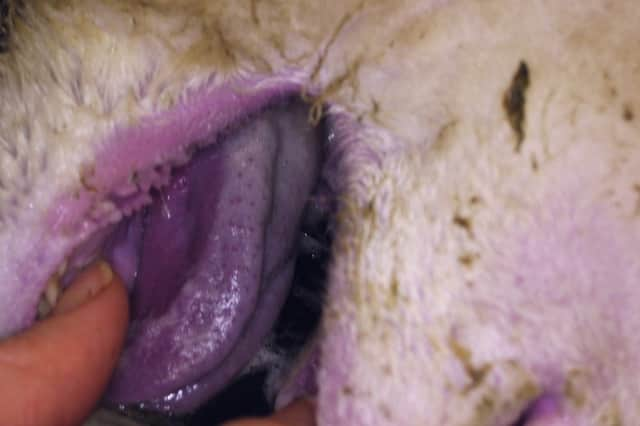
Sheep are more likely to show obvious clinical signs of bluetongue than cattle if they become infected with bluetongue virus. Signs of bluetongue in sheep include:
- ulcers or sores in the mouth and nose;
- discharge from the eyes or nose and drooling from mouth;
- swelling of the lips, tongue, head and neck and the coronary band (where the skin of the leg meets the horn of the foot)
Other clinical signs include:
- red skin as a result of blood collecting beneath the surface;
- fever;
- lameness;
- breathing problems;
- abortion, foetal deformities and stillbirths;
- death.
Lambs can become infected with bluetongue virus before birth if the dam is infected while pregnant. Signs of infection include:
- lambs born small, weak, deformed or blind;
- death of lambs within a few days of birth;
- stillbirths.
Signs of bluetongue in cattle include:
- lethargy;
- crusty erosions around the nostrils and muzzle;
- redness of the mouth, eyes, nose;
- reddening of the skin above the hoof;
- nasal discharge;
- reddening and erosions on the teats;
- fever;
- milk drop;
- not eating;
- abortion, foetal deformities and stillbirths.
Adult cattle may be infectious for several weeks while showing little or no sign of disease. They are often the preferred host for the biting midges that carry and transmit bluetongue virus.
Calves can become infected with bluetongue virus before birth if the mother is infected while pregnant. Signs of infection include:
- calves born small, weak, deformed or blind;
- death of calves within a few days of birth;
- stillbirths.
Source: DEFRA