
Scientists at University of Central Lancashire uncover exciting new discovery about space

Scientists in Lancashire have uncovered an exciting new discovery about the formation of planets with the help of computer simulations.
Researchers at the University of Central Lancashire (UCLan) used computer simulations to model the formation of planets.
The researchers said it is the first time scientists have looked at the shape of newborn planets in simulations as they form.
Dr Dimitris Stamatellos, reader in astrophysics at UCLan, said these young planets are oblate spheroids – spheres squashed from the top and the bottom but bulging in the middle.
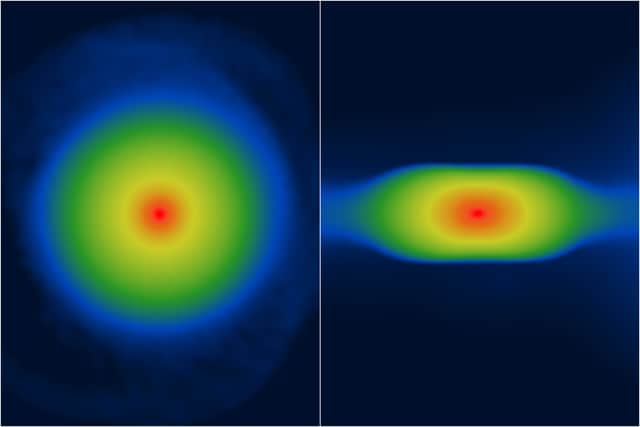

He said: "We have been studying planet formation for a long time but never before had we thought to check the shape of the planets as they form in the simulations.
"We had always assumed that they were spherical.
"We were very surprised that they turned out to be oblate spheroids, pretty similar to Smarties!"
Technically, no planet is fully spherical.
Dr Stamatellos said Jupiter's flattening, for example, is around 6%, while Saturn is 10%, and Earth is almost spherical at just 0.3%.
He said that young planets on the other hand are much flatter, somewhere around 90%.
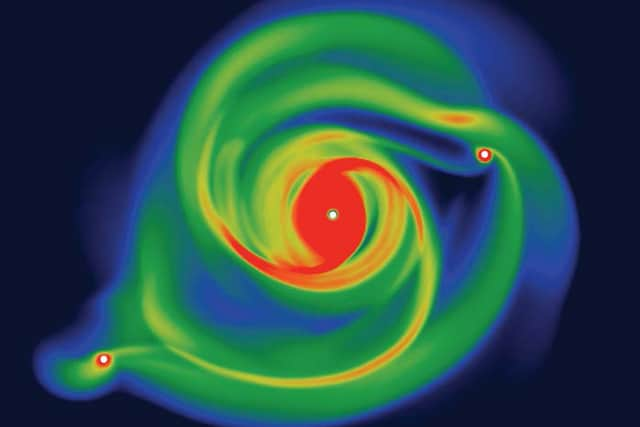
For their study, published in the journal Astronomy & Astrophysics Letters, the team investigated the shapes of young planets and how they grow to become gas giants like Jupiter.
The scientists also discovered that new planets grow as material falls on to them, mainly from their poles rather than their equators.
They said the findings have important implications, particularly when viewing planets through a telescope as their shapes will vary depending on the viewing angle.
The researchers said observational confirmation of the Smarties-like shape of young planets could also help answer a key question about how they form.
There are two theories on planet formation. The first and most widely accepted one is the core accretion model, where dust particles gradually grow and stick together to form large planets in long timescales.
But while this works well to explain the formation of planets such as Earth it does not fully account for gas giants – ones much larger than Jupiter – as the process would take too long.
The second theory – which is disk instability – is less favoured but may account for the creation of larger planets at rapid timescales.
The researchers said their work points towards the disc instability model rather than the core accretion one.
Dr Adam Fenton, a recently graduated PhD student at UCLan's Jeremiah Horrocks Institute for Mathematics, Physics and Astronomy, who led the research, said: "Many exoplanets, which are planets that orbit stars in other solar systems outside of our own, have been discovered in the last three decades.
"Despite observing many thousands of them, how they form remains unexplained.
"It is believed that they either form through core accretion, which is a gradual growth of dust particles that stick together to form progressively larger and larger objects on long timescales, or directly by the breaking up of large rotating protostellar discs around young stars in short timescales, which is what we call the theory of disk instability.
"This theory is appealing due to the fact that large planets can form very quickly at large distances from their host star, explaining some exoplanet observations."